

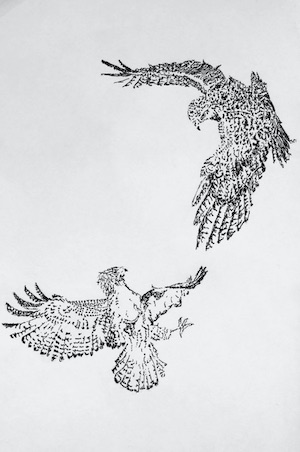
Against a cerulean sky the two forms materialized like inkblots on couché. It didn’t take long to identify the twin figures as a pair of red-tailed hawks. I paused to observe their rise, thermals and lazy loops lifting them up toward the stratosphere. With little aplomb or warning (at least to a distant land-bound observer), one hawk halted mid circle, folded his wings, tipped forth his head, and plunged seven stories straight down. He had already pulled out in a swooping “U” and rejoined his mate by the time I had registered that I was the lucky witness to a red-tailed hawk courtship ritual.
Beneath the sweeping cries of the hormonal hawks, I was overtaken by a soaring blend of inspiration and envy—how I longed for such thrill and abandon, to slip from human responsibilities and indulge my animal desire for that heart-skidding, stomach-thumping rush of adrenalin where existence is cast to courage, wind, and some well-placed feathers. Free as a bird, indeed.
Since infancy, birds have been a consistent and visible presence in my life. As the daughter of an avid birder, I learned to differentiate American robins from spotted towhees as most children do tables from chairs. It was common knowledge that blue jays live in the east and Steller’s jays in the west and that the Canada jay will eat peanuts straight from your hand.
That humans had any inherent interest in birds was so accepted that I failed to consider it notable. The fact that most people did not drive hours to stand behind a scope at the side of some sewage pond in hopes of spotting a wayward American avocet, that most freezers were not stuffed with roadkill birds waiting to be sent to museums (as our’s was to the horror of elementary school friends), was evidence to me that most people had no interest in birds whatsoever. It took a pandemic to understand that, while perhaps less pronounced than the fervent avian obsession to which my childhood had been exposed, we as a species are hopelessly enchanted by birds.
The rise in interest in birds during the early COVID 19 lockdowns has been well documented. Feeder sales and traffic to bird-related Wikipedia pages spiked and the Cornell Lab of Ornithology’s annual “big day” boasted a record-breaking number of reported sightings in 2021.
Theories pertaining to this sudden birding renaissance have been prolific with many acknowledging the hobby’s compatibility with the quarantine lifestyle—when desperate for opportunities to escape the confines of the interior world but unable to congregate in large groups, bird watching proves the ideal solitary outdoor activity.
Halcyon
Meaning “calm or peaceful,” halcyon is a Latin variant on the Greek alkyon, for kingfisher. Stemming from hals “sea” combined with kyon “to conceive,” the name is associated with the Greek myth of Alkyone, daughter of the god of wind, Aeolus, who threw herself into the sea upon the death of her husband and was transformed into a kingfisher. Aeolus thus calmed the sea so that Alkyone and her fellow kingfishers could build floating nests and hatch their eggs. The phrase “halcyon days” is thus a reference to this mythological period of calm.
Gander
An offshoot of the Old English gandra or male goose, it is believed that the word as a verb is inspired by the motion of a goose, specifically of its neck.
Crown
Hailing from the early twelfth century and denoting a wreath-like headpiece often worn by royalty, “crown” can be traced to the Latin corona, “wreath or garland,” which, it has been hypothesised, was derived from the Greek korōnē, or “crow/raven.” According to Dutch linguist Robert S. P. Beekes, korōnē, came to act as a metaphor for “all kinds or curved or hooked-formed objects,” as inspired by perhaps the curved shape of the beak or talons of a crow.
Over a year-and-a-half into the pandemic, however, with society reestablishing a semblance, albeit altered, of pre-COVID normalcy, the interest in birds has maintained where other quarantine-fueled hobbies have ebbed. Evidently there is something about birds.
This enthusiasm for all things avian is far from new. Among the prehistoric beasts of France’s Chauvet Cave is a 30,000-year-old engraving of a long-eared owl (with its head turned a full 180 degrees) and no consular election in ancient Rome could be confirmed without the approval of an “augur” who was tasked with interpreting of the will of the gods through observing the flight patterns of birds (each presidential “inauguration,” is in fact a direct reference to the Late Latin phrase, inauguratio, which describes the “ceremony by which the augurs obtained, or endeavored to obtain, the sanction of the gods to something which had been decreed by man”).
Many other English words and phrases sport reference to our feathered friends. Beyond the obvious idioms (“a little birdie told me,” “fly in the face of reason,” “what’s good for the goose . . .” etc.), our species’ volucrine predilection becomes evident each time we yearn for those halcyon days, take a gander around, or wear a crown.
Though my focus lies within the confines of English and thus draws from a European tradition, bird-centric symbolism extends far beyond the West. Noting that “people everywhere and throughout history seek meaning . . . most frequently from the natural world,” Felice S. Wyndham and Karen E. Park observed in “‘Listen Carefully to the Voices of the Birds’: A Comparative Review of Birds as Signs,” that ethnobiological studies across the globe have revealed that a significant portion of natural elements given symbolic significance are birds (Wyndham and Park).
This appeal of birds as symbolizers is multifaceted. David C. Lahti in “Culture, Religion, and Belief Systems: Birds as symbols in different cultures,” posits that:
Among the many objects in nature that are suitable for our symbolic use, the bird enjoys a privileged position because it is conspicuous, humanlike in many ways, and behaviorally interesting. Most birds are about in the daytime and tolerant of humans; they tend to be socially monogamous and provide parental care; they can be brightly colored and energetic; many of them sing loudly, distinctly, and beautifully; their activity tends to be obvious and provides easy insights to their lives; and among them are superb navigators, migrators, and builders. Above all, however, birds are excellent objects for our symbolic exploitation because they fly. (Lahti)
Recognizing the persistent presence of birds in human language, I find myself facing two personal quandaries: how does my relationship to language influence my understanding of birds? And how do I as a writer want to use language to talk about birds?
To better understand the relationship between birds and language (and why it matters to me), we must take a brief foray into the field of semiotics (forgive me, actual semioticians, as this is more me—a mere creative writing major who 3.0’d the single linguistics course I ever took—taking a concept I only somewhat understand and running (flying?) with, rather than actually interpreting it).
Father of semiotics, Swiss linguist Ferdinand de Saussure, modeled human language as a “dyadic” relationship between a “signifier” and “signified,” with the “signifier” serving as the tangible form an expression or sign takes and the “signified” the intangible sensation or concept about which one can only communicate through use of a sign (Chandler).
Linguists have expanded upon Saussure’s idea (which generally stuck exclusively to spoken language and sounds as signifiers i.e. the creation of words), suggesting metaphors too are signs. Perhaps the most obvious avian example of this phenomenon is the image of a bird in flight and how—because it travels along a plane upon which we are restricted—it has come to represent freedom.
My response to watching the courting redtails came not from some scientific understanding of buteo behavior, but learned cultural cues rooted in a tradition of creating signs out of birds. Laden upon their wings are emotions, expectations, situations. Quite the linguistic burden.
Now this is all very fine and good—birds serve as great signifiers for human concepts—but how is it relevant to writing and this blog specifically?
Observing the plunging red-tail, I instantly ascribed to him my own emotional lexicon, assuming his sensations much reflect those of myself were I to take a similar plunge. I begin wondering whether I actually saw the individual hawk at all.
I would argue that writing, in a wonderfully chiasmic manner, serves as an attempt at creating new signs. What is a book but a complex representation of a thought or series of thoughts? In writing about birds, one not only is one dissecting pre-established sign-relationships (why do we associate the owl’s hoot with death?), but crafting their own signifier in the form of a composition on their signified impression of the bird in question.
Lost? I certainly am. But that’s alright, I think.
There’s nothing wrong with a good metaphor and there’s obviously something about birds. The chickadee’s twittering song, the nimble dance of the sandhill crane—these actions enchant humans, inspire in us emotions so strong they become communally understood. Perhaps I was wrong to assume my interest in the plunging hawk was purely typifying.
I tilt my head in a physical representation of intrigue, borrowing from birds so much so I describe the action as “cocking” my head. It’s hard to not assume the crow outside my window is not lost in similar confusion when she makes the same motion in my direction. But simultaneously, she is not here to represent how I feel and I am certainly not here to understand her as a manifestation of my own solipsism.
I hesitate to propose that we, as humans, can ever fully extricate ourselves from our own self-centered narratives, but I do wonder if, by altering the way we understand our fellow earth-dwellers, expanding their existence beyond that of handy signs, tired metaphors, we can expand our relationships both with them, and with ourselves.
Works Cited
- Chandler, Daniel. Semiotics for Beginners. 1994 http://www.aber.ac.uk/media/Documents/S4B/semiotic.html
-
Dhanesha, Neel. “Birdwatching is a Bright Spot in a Pandemic-Stricken Economy.” Audubon Magazine, 06 August 2020, Online. https://www.audubon.org/news/birdwatching-bright-spot-pandemic-stricken-economy.
- Harrison, Sara. “Pandemic Bird-Watching Created a Data Boom— and a Conundrum.” Wired, Science. 30 September 2021, Online. https://www.wired.com/story/pandemic-bird-watching-created-a-data-boom-and-a-conundrum/
-
Lahti, David C. “Birds as symbols in human culture.” M Beckoff (ed.), Encyclopedia of Human-Animal Relationships. Westport, CT: Greenwood Publishing Group, 451-458, (2007).
- MacLellan, Lila. “New Data Shows that Birding Mania isn’t Just a Lockdown Fad.” Quartz, 25 June 2021, Online. https://qz.com/2024279/birdings-popularity-is-lasting-beyond-the-pandemic/
-
Park, Karen E., Wyndham, Felice S. “‘Listen Carefully to the Voices of the Birds’: A Comparative Review of Birds as Signs,” Journal of Ethnobiology 38(4), 533-549, (21 December 2018). https://doi.org/10.2993/0278-0771-38.4.533
- “The Owl.” The Art of the Chauvet Cave. Bradshaw Foundation. https://www.bradshawfoundation.com/chauvet/owl.php
-
“You Won’t Believe These 10 Words Come from Birds.” Merriam-Webster, Merriam-Webster, https://www.merriam-webster.com/words-at-play/auspicious-volatile-musket-and-other-words-related-to-birds/cajole
 Sophie Aanerud