A month ago, I learned that house wrens exist. While peeling through my guide books for a match to the dull (but very loquacious) wren I saw hopping around a local community garden, I was embarrassed to discover that, not only was it not Carolina wren as I had suspected (my second guess was that it was a Bewick’s wren and turns out those don’t even live on the East Coast), but that this “house wren” is actually among the most widespread species of wrens in the Americas. Suffice to say, it was time I learned my wrens.
Seeing Double? You may be noting that two of these birds, the winter wren and Pacific wren, appear basically identical. While there are slight differences in throat color and call notes, so long as you’re not an ornithologist (or find yourself in Tumbler Ridge in the Canadian Rockies, where both species have overlapping ranges), your best bet on identification is going to be a range map. A comprehensive (and frankly fascinating) overview of the 2008 study that sparked the classification shift can be found here.
A family of passerine birds confined to the New World with one exception (I’m not ready to discuss the baffling range of the Eurasian wren), there are approximately 88 species of wrens (the family’s Latin name being Troglodytidae in reference to the attraction of some wrens to small dark crevices). Considering my North American bias, I’m currently only worrying about learning ten.
Though definitely fitting under the umbrella of Little Brown Birds, wrens are pretty easy to differentiate from other families filed under that dreaded denomination on account of their long, slender bills, chatty nature, and propensity to keep their tails up-cocked. I was probably eight when my dad and I built a bird box for Bewick’s wrens, and I never had any trouble distinguishing them from the sparrows and juncos that were also regular visitors to our yard. Though distinct as a family, things get stickier when trying to identify individual species. With a few exceptions, most North American wrens can be described as small, round birds with distinctively pale eyebrow lines, dark brown backs, and barring on the wings. Birders often rely on range, habitat, and song as identification cues.
Of course, sometimes you have overlap, (such as during summer in Philadelphia) and thus I turned to drawing to get a better sense of the more subtle variations in shape and plumage between, say, Carolina wrens and house wrens (this project also afforded me some much-needed practice with colored pencils, a medium with which I’ve always struggled).
You’ll notice my plate doesn’t include every species of North American wren. Honestly, this choice was largely based on my personal identification issues: rock wrens, cactus wrens, and canyon wrens are pretty distinct on account of size, plumage, and habitat.
And with sedge wrens, well, my most sincere apologies, the fact that I included marsh wrens and not sedge wrens just goes to show my west coast bias. The good news is, telling a sedge wren from a marsh wren is pretty doable in general as sedge wrens stick to the shallow marshes while marsh wrens embed themselves deep in the wettest, reediest corners; if you’re still uncertain, look for barring on the shoulders—sedge wrens have it and marsh wrens don’t.
Do I know my wrens better after drawing a bunch of them? The moment of truth occurred during a walk through DC’s Roosevelt Island when I managed to focus my binocs on a little brown bird hopping about the underbrush. Ruddy plumage, sharp white brows, and up-cocked tail feathers: it was a Carolina wren alright!
I MADE A MISTAKE: Perhaps you noticed that I initially had the wrong genus included in my sketch. Well, it seems I made a classic mistake in bird identification and failed to cross-check the facts provided by my six-year-old Sibley guide. Bird classification is constantly in flux, with ornithologists working to balance older observation-based classification with genetic revelations. The story of the ruby-crowned kinglet’s genus-designation is especially messy: though long considered a member of the Regulidae family, this tiny bird’s genus was changed from “Regulus” (that of all other members of the family) to “Corthylio” in 1931 based on “morphological differences from the other species,” only to be inexplicably switched back by the American Ornithological Society (AOS) in 1957; taking into account vocal and genetic data, the AOS voted to again move the ruby-crowned kinglet to a unique genus in 20211.
I’m hesitant to bring friends birding with me. If you’re not that into birds, it’s incredibly boring (having spent the majority of my life in that unique position of having no choice but to join my dad on birding expeditions despite my being “not that into birds,” I can attest). I never believed that I would inculcate my dad’s immense patience. Hours turning to days spent scoping the shoreline for a single great black-tailed gull disguised against tens of thousand of California gulls (a process I have sat through) may remain beyond my tolerance, but as my appreciation for birds has increased, so has the length of time I am willing to spend standing in silence, binoculars in hand.
This was the position I found myself in today, after having followed a house wren into a thicket of holly and juniper. The wren spirited off in some different direction (which could basically be considered a different dimension for how good a chance I had of relocating it), but this was migration season and the rustle of displaced leaves far above confirmed my suspicions that the canopy was deceptively active. As most songbirds migrate by night, using the stars for navigation, dense canopies in greenbelts such as the one in which I had wandered are often thick with resting migrant birds in the daytime.
I was hoping for warblers, flighty little songbirds that winter along the equator and bring their cheery tropical plumage with them as they cross the US for higher latitudes come spring. While I managed a quick glimpse at what I think was a northern parula, I lost the little guy the moment I reached for my binoculars, par for the course. After fifteen minutes, my neck craned beneath the grove holly, I was greeted by a bird I had failed to consider: a ruby-crowned kinglet!
These petite (averaging four inches from bill to tail tip and weighing a quarter of an ounce2), olive-colored birds are not the most striking at first glance, nor will they earn you many points for rareness as they can be found across the southern United States and as far north as coastal New England year-round3 (for the record, where I grew up in Seattle, ruby-crowned kinglets were a breeding-season-only find), but there’s something undeniably charming about them. For a good five minutes I watched the little guy bob from branch to branch, pausing to sing a few high tsee notes. I’ve always regarded tiny songbirds, be they chickadees or bush tits or ruby-crowned kinglets, with a bit of incredulity—what could this little guy be thinking, how does he interpret this expansive world as he cocks his head and blinks his black seed-bead eyes? Evidently, this one was thinking about potential mates, as he followed his song by flashing a theretofore obscured mohawk of crimson feathers. A plenty-sufficient reward for my patience, in my opinion.
If spring could be summated in a single sound, for me it would be the song of the American robin (Turdus migratorius). The roving series of whistles exchanged at increasingly high volumes greeted me before school every April, May, and June morning, and on the opposite side of the country, they still do, imbuing my mornings with nostalgic familiarity. Though I regard them largely with fondness, this is not to say that the robins are never an annoyance—the birds are among the earliest of risers, often starting their dialogues at four in the morning.
As identifiable as their call can be, American robins probably owe their status as a universally identifiable bird (“universal” in this case referring to “across North America”) to their penchant for the urban and suburban landscape, their unique behavior, and distinct plumage. Indeed, the prolific birds are among the most numerous and wide-spread songbirds in North America1, and subsequently carry cultural prominence, often dubbed a “harbinger of spring” (much thanks to Emily Dickinson for that one). Though they are among the first North American songbirds to begin nesting each year, they can usually be found in a given location year round (though likely the individuals one sees in winter are not the same as those present in the summer, as robins do tend to migrate, but not to a specific latitude or for a predictable distance).2 This being said, the birds will move based on available food, and as food is most plentiful in the spring, their ranges are vaster.
All this is to say, I am writing this is Philadelphia in mid April and there are robins abound. Averaging two to three broods per year between April and July,3 they are in mating mode and looking good (the scrappy fledglings so present in the summer have yet to emerge). Watching them hop about in search of worms and grubs, flitting from branches of the dense shrubs in which they’ve secured their nests, it’s impossible to not hoist a bit of literary significance upon their delicate frames—American robins are just too charming.
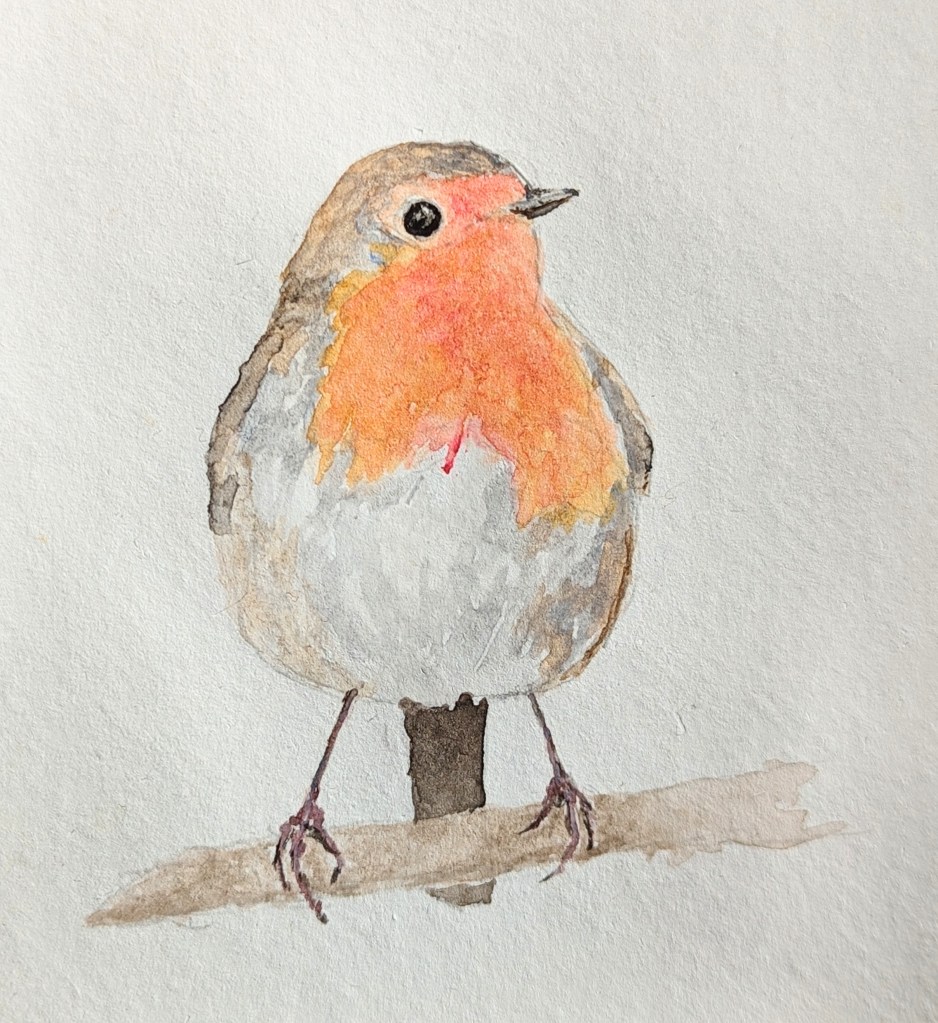
Why do American robins look nothing like Old World robins?
The European robin is small, plump, and markedly different from its taller and more stately American counterpart.
The first time I saw a picture of an Old World robin, I was perplexed. Little did I know, I was just scratching the surface. “Robins” exist in Asia, Africa, Europe, Oceania, and the Americas, and none of them are related. As per usual, the English are to blame, with Anglo ornithologists dubbing any bird with plumage similar to that of the red-breasted European robin (a member of the “chat” subfamily of the Old World flycatchers), a “robin.”4 While the robins of Oceania, for example, may appear similar is size and shape to the OG European robin, they actually compose a unique family, Petroicidae, more closely related to Jays5. Similarly, American robins are members of the Turdidae family of thrushes (a family completely different in build and behavior to Old World flycatchers). Because of their wide range, American robins are known by a variety of (more fitting) indigenous names, including “opitchi” in Ojibwa (thought to be an onomatopoeic representation of their calls),6 and “nikchipkudaagedoo,” in Mi’kmaq, which translates to “leaf rattler.”7
Seizing on a spell of disconcertingly warm weather in late January, I grabbed my binoculars and made the 20-minute walk to The Woodlands, a 15-acre cemetery and beloved West Philly greenbelt. With U Penn’s sprawling medical facilities to the east, dense residential blocks to the north and west, and the industrial clangor of Forgotten Bottom south across the Schuylkill River, The Woodlands exists as an aptly named expanse of greenery attractive to birds both migratory and residential.
Amidst the tombstones of Union soldiers and Philly’s Victorian-era elites, I admired a bald eagle pair circling above, northern mockingbirds perched picturesque upon stone angels, and at least 40 white-throated sparrows shuffling to and fro in the leaf litter. It was a familiar upside-down-V-for-peace that caught my attention, drawing me toward a flock of small sparrows fluttering between a willow’s twisted branches.
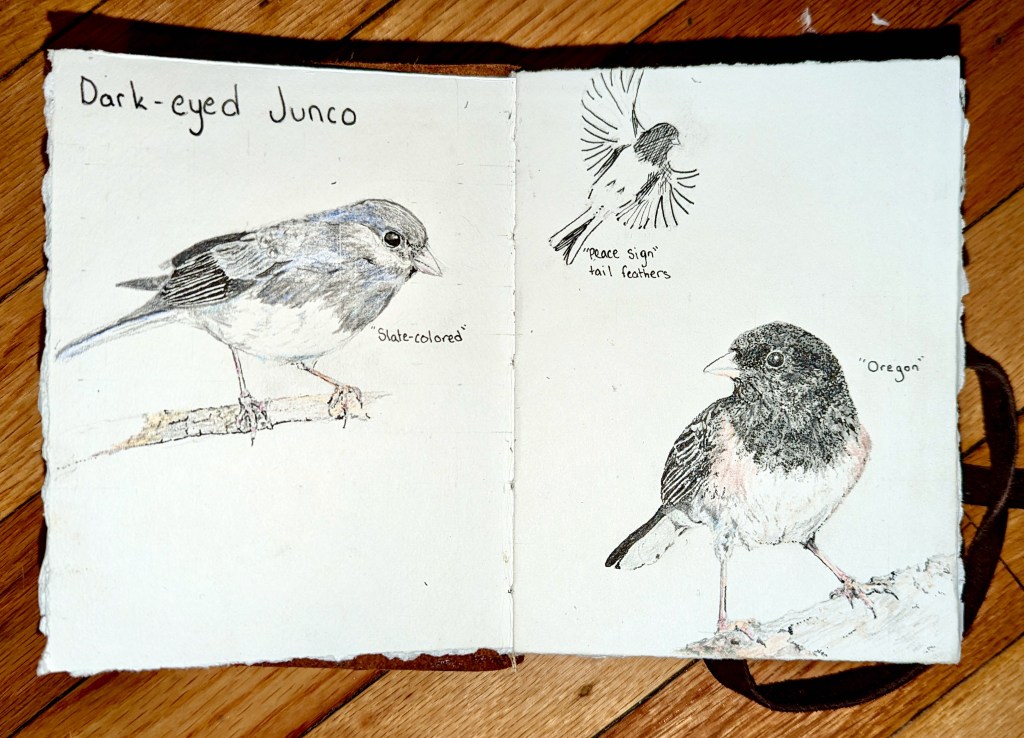
Most Emberizine sparrows and allies–a notoriously frustrating enclave of “little brown birds”–exist far beyond my identification abilities, but dark-eyed juncos have always stood out for me as welcoming exceptions. With minimal sexual dimorphism, dark-eyed juncos lack their cousins’ bashfulness, often congregating beneath winter-time feeders, flashing white upside-down “V”s on their tail feathers and bobbing their dusky heads so distinct against their rust-colored bodies.
Approaching the willow, I paused, confidence failing as the tiny birds came into view. Sure these creatures were shaped like juncos, sported the pale-rose bills and flashed the tail feathers of juncos, but otherwise their plumage was all wrong. The reddish shoulders I had anticipated were sooty grey. The entirety of these birds’ bodies were, in fact, grey, save a bit of ivory at the belly. Gone were the high contrasts of black, rust, and white with which I had grown so accustomed.
A brief rendezvous with my Sibley Guide affirmed my first impression that these little guys had indeed been dark-eyed juncos, but reminded me of a critical caveat regarding bird identification: regional variation. Six distinct regional populations of dark-eyed juncos exist; they all share enough distinctive traits to be considered the same species, but diverge significantly in size and plumage. It turns out that the “slate-colored” variety that had thrown me for such a loop at the cemetery are the most common variety in North America, wintering in most parts of the US and living year-round in New England and south through Appalachia. Having grown up in the Pacific Northwest, however, I learned to identify the smaller and more flashy “Oregon” variety. Who knows what I’d have thought had I been raise in southern New Mexico where the “pink-sided” and “red-backed” varieties reign supreme.
Of course distinctions between “races,” “sub-species,” and “species” are fuzzy at best, having been determined by a small enclave of ornithologists. I can recall my childhood confusion when the blue grouse was split into two species, the sooty grouse and dusky grouse, which, as far as I could see were identical save living on different sides of a mountain range. Frankly that one still baffles me. If anything, this junco-revelation has served as a good reminder, especially for a bi-coastal bouncer such as myself, that birds, like humans, are diverse.
On a recentbackpacking trip in Big Sur during their spring migration, I counted over 20 California newts casually making their way to streams for breeding.
The first time I encountered a rough-skinned newt, I scooped the little guy up without a second thought. Used to lizards that flee at the hint of danger, I was amazed by the small amphibian’s cavalier attitude: he couldn’t care less, it seemed, to have been transferred from the trail upon which he was strolling onto the palm of this comparatively massive warm-blooded potential predator; my friend and I dubbed him “Newton,” and snapped a couple pictures before returning him to earth. I texted my dad a picture, as I do upon most nature-related discoveries. Expecting an enthusiastic one-word response the next day, I was caught off guard to receive a call from him within minutes of the text.
“Did you pick up that newt?” He asked with underlying urgency.
I replied that of course I had, that this should be obvious as the photo depicted the newt in my hand.
His response was less amused than I had anticipated. “Are you able to wash your hands? Don’t touch your face or any food until you can wash your hands.”
As he told me this, my friend, who had also handled the newt, complained that his finger was tingling a little. My stomach lunged.
In short, we were fine. We washed and sanitized our hands upon returning from the hike and within a couple hours the irritation to my friend’s finger had dissipated. Still, I was disturbed by how casually we had handled what was in fact one of most dangerous animals in the country.
Perhaps “dangerous” is not the best term. The genus Taricha, which is composed of four species of newts (rough-skinned newts, California newts, Sierra newts, and red-bellied newts) have only one confirmed human kill to their name, but still, considering we’re talking about a five-inch-long newt taking down a 29-year-old adult man (spoiler, the newt didn’t live to tell the tale), these seemingly-innocuous amphibians aren’t to be taken lightly.
Endemic to the west coast of the United States and Canada, Taricha members are relatively non-descript: they range between about three and seven inches in length, have brown, bumpy skin (though the skin of males often becomes smoother come mating season), and bright orangey-yellow bellies that they flash if feeling threatened . . . they also all possess the biotoxin, tetrodotoxin, a neurotoxin 1,200 times more toxic than cyanide.
Most commonly associated with pufferfish and the blue-ring octopus, tetrodotoxin, when consumed in large-enough quantities, can result in numbness, paralysis, and asphyxiation. Though rough-skinned newts generally possess the highest levels of tetrodotoxin, and levels can fluctuate within species regionally, it is agreed that all Taricha members sport high enough amounts to cause significant damage.
How these newts came to carry this toxin, which is typically attributed to aquatic bacteria, remains unclear, though a 2020 study identified several types of tetrodotoxin-producing bacteria living on the bumpy skin of these newts, indicating that they are not able to produce the toxin themselves. It is clear that, because of this epidermal weapon, these newts have few natural predators (garter-snakes being a unique exception) and thus tend to mosey along exposed trails without concern (on a recent backpacking trip in Big Sur during their spring migration, I counted over 20 California newts casually making their way to streams for breeding; not one made any effort to get out of my way).
This sluggishness, combined with their innocuous appearance proved lethal—for both newt and human—in 1979 when a 29-year-old man, during a night of drunken antics, swallowed a rough-skinned newt on a dare. Within 24 excruciating hours, the man had died by asphyxiation.
Fortunately, aside from some potential skin irritation, not much damage can come from handling Taricha, so long as you don’t, you know, eat it or lick your fingers. Still, I can’t help but feel a little duped: for as long as I can remember, I—a Pacific Northwesterner—knew to be weary of southern threats such as gila monsters (there is no confirmed report of this magnificently sluggish lizard ever killing anyone) and tarantulas (again, no reported kills), but no one ever mentioned the toxic charmer living in my own backyard.
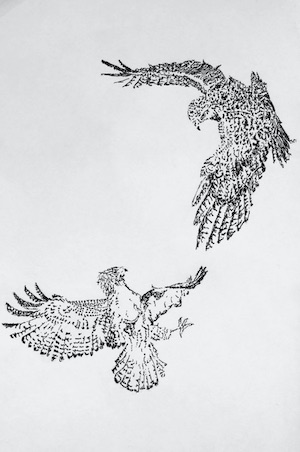
Against a cerulean sky the two forms materialized like inkblots on couché. It didn’t take long to identify the twin figures as a pair of red-tailed hawks. I paused to observe their rise, thermals and lazy loops lifting them up toward the stratosphere. With little aplomb or warning (at least to a distant land-bound observer), one hawk halted mid circle, folded his wings, tipped forth his head, and plunged seven stories straight down. He had already pulled out in a swooping “U” and rejoined his mate by the time I had registered that I was the lucky witness to a red-tailed hawk courtship ritual.
Beneath the sweeping cries of the hormonal hawks, I was overtaken by a soaring blend of inspiration and envy—how I longed for such thrill and abandon, to slip from human responsibilities and indulge my animal desire for that heart-skidding, stomach-thumping rush of adrenalin where existence is cast to courage, wind, and some well-placed feathers. Free as a bird, indeed.
Since infancy, birds have been a consistent and visible presence in my life. As the daughter of an avid birder, I learned to differentiate American robins from spotted towhees as most children do tables from chairs. It was common knowledge that blue jays live in the east and Steller’s jays in the west and that the Canada jay will eat peanuts straight from your hand.
That humans had any inherent interest in birds was so accepted that I failed to consider it notable. The fact that most people did not drive hours to stand behind a scope at the side of some sewage pond in hopes of spotting a wayward American avocet, that most freezers were not stuffed with roadkill birds waiting to be sent to museums (as our’s was to the horror of elementary school friends), was evidence to me that most people had no interest in birds whatsoever. It took a pandemic to understand that, while perhaps less pronounced than the fervent avian obsession to which my childhood had been exposed, we as a species are hopelessly enchanted by birds.
The rise in interest in birds during the early COVID 19 lockdowns has been well documented. Feeder sales and traffic to bird-related Wikipedia pages spiked and the Cornell Lab of Ornithology’s annual “big day” boasted a record-breaking number of reported sightings in 2021.
Theories pertaining to this sudden birding renaissance have been prolific with many acknowledging the hobby’s compatibility with the quarantine lifestyle—when desperate for opportunities to escape the confines of the interior world but unable to congregate in large groups, bird watching proves the ideal solitary outdoor activity.
Halcyon Meaning “calm or peaceful,” halcyon is a Latin variant on the Greek alkyon, for kingfisher. Stemming from hals “sea” combined with kyon “to conceive,” the name is associated with the Greek myth of Alkyone, daughter of the god of wind, Aeolus, who threw herself into the sea upon the death of her husband and was transformed into a kingfisher. Aeolus thus calmed the sea so that Alkyone and her fellow kingfishers could build floating nests and hatch their eggs. The phrase “halcyon days” is thus a reference to this mythological period of calm.
Gander An offshoot of the Old English gandra or male goose, it is believed that the word as a verb is inspired by the motion of a goose, specifically of its neck.
Crown Hailing from the early twelfth century and denoting a wreath-like headpiece often worn by royalty, “crown” can be traced to the Latin corona, “wreath or garland,” which, it has been hypothesised, was derived from the Greek korōnē, or “crow/raven.” According to Dutch linguist Robert S. P. Beekes, korōnē, came to act as a metaphor for “all kinds or curved or hooked-formed objects,” as inspired by perhaps the curved shape of the beak or talons of a crow.
Over a year-and-a-half into the pandemic, however, with society reestablishing a semblance, albeit altered, of pre-COVID normalcy, the interest in birds has maintained where other quarantine-fueled hobbies have ebbed. Evidently there is something about birds.
This enthusiasm for all things avian is far from new. Among the prehistoric beasts of France’s Chauvet Cave is a 30,000-year-old engraving of a long-eared owl (with its head turned a full 180 degrees) and no consular election in ancient Rome could be confirmed without the approval of an “augur” who was tasked with interpreting of the will of the gods through observing the flight patterns of birds (each presidential “inauguration,” is in fact a direct reference to the Late Latin phrase, inauguratio, which describes the “ceremony by which the augurs obtained, or endeavored to obtain, the sanction of the gods to something which had been decreed by man”).
Many other English words and phrases sport reference to our feathered friends. Beyond the obvious idioms (“a little birdie told me,” “fly in the face of reason,” “what’s good for the goose . . .” etc.), our species’ volucrine predilection becomes evident each time we yearn for those halcyon days, take a gander around, or wear a crown.
“My response to watching the courting redtails came not from some scientific understanding of buteo behavior, but learned cultural cues.“
Though my focus lies within the confines of English and thus draws from a European tradition, bird-centric symbolism extends far beyond the West. Noting that “people everywhere and throughout history seek meaning . . . most frequently from the natural world,” Felice S. Wyndham and Karen E. Park observed in “‘Listen Carefully to the Voices of the Birds’: A Comparative Review of Birds as Signs,” that ethnobiological studies across the globe have revealed that a significant portion of natural elements given symbolic significance are birds (Wyndham and Park).
This appeal of birds as symbolizers is multifaceted. David C. Lahti in “Culture, Religion, and Belief Systems: Birds as symbols in different cultures,” posits that:
Among the many objects in nature that are suitable for our symbolic use, the bird enjoys a privileged position because it is conspicuous, humanlike in many ways, and behaviorally interesting. Most birds are about in the daytime and tolerant of humans; they tend to be socially monogamous and provide parental care; they can be brightly colored and energetic; many of them sing loudly, distinctly, and beautifully; their activity tends to be obvious and provides easy insights to their lives; and among them are superb navigators, migrators, and builders. Above all, however, birds are excellent objects for our symbolic exploitation because they fly. (Lahti)
Recognizing the persistent presence of birds in human language, I find myself facing two personal quandaries: how does my relationship to language influence my understanding of birds? And how do I as a writer want to use language to talk about birds?
To better understand the relationship between birds and language (and why it matters to me), we must take a brief foray into the field of semiotics (forgive me, actual semioticians, as this is more me—a mere creative writing major who 3.0’d the single linguistics course I ever took—taking a concept I only somewhat understand and running (flying?) with, rather than actually interpreting it).
Father of semiotics, Swiss linguist Ferdinand de Saussure, modeled human language as a “dyadic” relationship between a “signifier” and “signified,” with the “signifier” serving as the tangible form an expression or sign takes and the “signified” the intangible sensation or concept about which one can only communicate through use of a sign (Chandler).
Linguists have expanded upon Saussure’s idea (which generally stuck exclusively to spoken language and sounds as signifiers i.e. the creation of words), suggesting metaphors too are signs. Perhaps the most obvious avian example of this phenomenon is the image of a bird in flight and how—because it travels along a plane upon which we are restricted—it has come to represent freedom.
My response to watching the courting redtails came not from some scientific understanding of buteo behavior, but learned cultural cues rooted in a tradition of creating signs out of birds. Laden upon their wings are emotions, expectations, situations. Quite the linguistic burden.
Now this is all very fine and good—birds serve as great signifiers for human concepts—but how is it relevant to writing and this blog specifically?
Observing the plunging red-tail, I instantly ascribed to him my own emotional lexicon, assuming his sensations much reflect those of myself were I to take a similar plunge. I begin wondering whether I actually saw the individual hawk at all.
I would argue that writing, in a wonderfully chiasmic manner, serves as an attempt at creating new signs. What is a book but a complex representation of a thought or series of thoughts? In writing about birds, one not only is one dissecting pre-established sign-relationships (why do we associate the owl’s hoot with death?), but crafting their own signifier in the form of a composition on their signified impression of the bird in question.
Lost? I certainly am. But that’s alright, I think.
There’s nothing wrong with a good metaphor and there’s obviously something about birds. The chickadee’s twittering song, the nimble dance of the sandhill crane—these actions enchant humans, inspire in us emotions so strong they become communally understood. Perhaps I was wrong to assume my interest in the plunging hawk was purely typifying.
I tilt my head in a physical representation of intrigue, borrowing from birds so much so I describe the action as “cocking” my head. It’s hard to not assume the crow outside my window is not lost in similar confusion when she makes the same motion in my direction. But simultaneously, she is not here to represent how I feel and I am certainly not here to understand her as a manifestation of my own solipsism.
I hesitate to propose that we, as humans, can ever fully extricate ourselves from our own self-centered narratives, but I do wonder if, by altering the way we understand our fellow earth-dwellers, expanding their existence beyond that of handy signs, tired metaphors, we can expand our relationships both with them, and with ourselves.
Lahti, David C. “Birds as symbols in human culture.” M Beckoff (ed.), Encyclopedia of Human-Animal Relationships. Westport, CT: Greenwood Publishing Group, 451-458, (2007).
Park, Karen E., Wyndham, Felice S. “‘Listen Carefully to the Voices of the Birds’: A Comparative Review of Birds as Signs,” Journal of Ethnobiology 38(4), 533-549, (21 December 2018). https://doi.org/10.2993/0278-0771-38.4.533





 Sophie Aanerud