Little Brown Birds: Wrens

A month ago, I learned that house wrens exist. While peeling through my guide books for a match to the dull (but very loquacious) wren I saw hopping around a local community garden, I was embarrassed to discover that, not only was it not Carolina wren as I had suspected (my second guess was that it was a Bewick’s wren and turns out those don’t even live on the East Coast), but that this “house wren” is actually among the most widespread species of wrens in the Americas. Suffice to say, it was time I learned my wrens. 

A family of passerine birds confined to the New World with one exception (I’m not ready to discuss the baffling range of the Eurasian wren), there are approximately 88 species of wrens (the family’s Latin name being Troglodytidae in reference to the attraction of some wrens to small dark crevices). Considering my North American bias, I’m currently only worrying about learning ten. 

Though definitely fitting under the umbrella of Little Brown Birds, wrens are pretty easy to differentiate from other families filed under that dreaded denomination on account of their long, slender bills, chatty nature, and propensity to keep their tails up-cocked. I was probably eight when my dad and I built a bird box for Bewick’s wrens, and I never had any trouble distinguishing them from the sparrows and juncos that were also regular visitors to our yard. Though distinct as a family, things get stickier when trying to identify individual species. With a few exceptions, most North American wrens can be described as small, round birds with distinctively pale eyebrow lines, dark brown backs, and barring on the wings. Birders often rely on range, habitat, and song as identification cues. 

Of course, sometimes you have overlap, (such as during summer in Philadelphia) and thus I turned to drawing to get a better sense of the more subtle variations in shape and plumage between, say, Carolina wrens and house wrens (this project also afforded me some much-needed practice with colored pencils, a medium with which I’ve always struggled). 

You’ll notice my plate doesn’t include every species of North American wren. Honestly, this choice was largely based on my personal identification issues: rock wrens, cactus wrens, and canyon wrens are pretty distinct on account of size, plumage, and habitat. 

And with sedge wrens, well, my most sincere apologies, the fact that I included marsh wrens and not sedge wrens just goes to show my west coast bias. The good news is, telling a sedge wren from a marsh wren is pretty doable in general as sedge wrens stick to the shallow marshes while marsh wrens embed themselves deep in the wettest, reediest corners; if you’re still uncertain, look for barring on the shoulders—sedge wrens have it and marsh wrens don’t.

Do I know my wrens better after drawing a bunch of them? The moment of truth occurred during a walk through DC’s Roosevelt Island when I managed to focus my binocs on a little brown bird hopping about the underbrush. Ruddy plumage, sharp white brows, and up-cocked tail feathers: it was a Carolina wren alright!

Works Cited

Young, B. (2007-2024). Classic Collection of North American Birds. Field Guide for all of the birds of North America: Wrens. CCNAB. https://www.birds-of-north-america.net/wrens.html

Cornell Lab: All About Birds (2024). Bird Guide: Troglodytidae. Cornell University. https://www.allaboutbirds.org/guide/browse/taxonomy/Troglodytidae

Sibley, D. (2010, August 13). Distinguishing Pacific and Winter Wrens. Sibley Guides. https://www.sibleyguides.com/2010/08/distinguishing-pacific-and-winter-wrens/

Bird of the day: Ruby-crowned Kinglet

I MADE A MISTAKE: Perhaps you noticed that I initially had the wrong genus included in my sketch. Well, it seems I made a classic mistake in bird identification and failed to cross-check the facts provided by my six-year-old Sibley guide. Bird classification is constantly in flux, with ornithologists working to balance older observation-based classification with genetic revelations. The story of the ruby-crowned kinglet’s genus-designation is especially messy: though long considered a member of the Regulidae family, this tiny bird’s genus was changed from “Regulus” (that of all other members of the family) to “Corthylio” in 1931 based on “morphological differences from the other species,” only to be inexplicably switched back by the American Ornithological Society (AOS) in 1957; taking into account vocal and genetic data, the AOS voted to again move the ruby-crowned kinglet to a unique genus in 20211.

I’m hesitant to bring friends birding with me. If you’re not that into birds, it’s incredibly boring (having spent the majority of my life in that unique position of having no choice but to join my dad on birding expeditions despite my being “not that into birds,” I can attest). I never believed that I would inculcate my dad’s immense patience. Hours turning to days spent scoping the shoreline for a single great black-tailed gull disguised against tens of thousand of California gulls (a process I have sat through) may remain beyond my tolerance, but as my appreciation for birds has increased, so has the length of time I am willing to spend standing in silence, binoculars in hand. 

This was the position I found myself in today, after having followed a house wren into a thicket of holly and juniper. The wren spirited off in some different direction (which could basically be considered a different dimension for how good a chance I had of relocating it), but this was migration season and the rustle of displaced leaves far above confirmed my suspicions that the canopy was deceptively active. As most songbirds migrate by night, using the stars for navigation, dense canopies in greenbelts such as the one in which I had wandered are often thick with resting migrant birds in the daytime.

I was hoping for warblers, flighty little songbirds that winter along the equator and bring their cheery tropical plumage with them as they cross the US for higher latitudes come spring. While I managed a quick glimpse at what I think was a northern parula, I lost the little guy the moment I reached for my binoculars, par for the course. After fifteen minutes, my neck craned beneath the grove holly, I was greeted by a bird I had failed to consider: a ruby-crowned kinglet! 

These petite (averaging four inches from bill to tail tip and weighing a quarter of an ounce2), olive-colored birds are not the most striking at first glance, nor will they earn you many points for rareness as they can be found across the southern United States and as far north as coastal New England year-round3 (for the record, where I grew up in Seattle, ruby-crowned kinglets were a breeding-season-only find), but there’s something undeniably charming about them. For a good five minutes I watched the little guy bob from branch to branch, pausing to sing a few high tsee notes. I’ve always regarded tiny songbirds, be they chickadees or bush tits or ruby-crowned kinglets, with a bit of incredulity—what could this little guy be thinking, how does he interpret this expansive world as he cocks his head and blinks his black seed-bead eyes? Evidently, this one was thinking about potential mates, as he followed his song by flashing a theretofore obscured mohawk of crimson feathers. A plenty-sufficient reward for my patience, in my opinion. 


Works Cited

  1. American Ornithological Society. (2021, June 29). In with the Old, Out with the Mew: Update to the Check-list of North American Birds Publishes Today in Ornithology. AOS Wingbeat. https://americanornithology.org/in-with-the-old-out-with-the-mew-2021-checklist-update/.
    ↩︎
  2. Pfeiffer, B. (2017, April 17). Behold the Male Ruby-crowned Kinglet in All Its Mating Majesty. Audubon BirdNote. https://www.audubon.org/news/behold-male-ruby-crowned-kinglet-all-its-mating-majesty ↩︎
  3. Sibley, D. A. (2016, March 29). The Sibley Field Guide to Birds of Western North America: Second Edition. New York : Alfred A Knopf. ↩︎

Bird of the day: American Robin

If spring could be summated in a single sound, for me it would be the song of the American robin (Turdus migratorius). The roving series of whistles exchanged at increasingly high volumes greeted me before school every April, May, and June morning, and on the opposite side of the country, they still do, imbuing my mornings with nostalgic familiarity. Though I regard them largely with fondness, this is not to say that the robins are never an annoyance—the birds are among the earliest of risers, often starting their dialogues at four in the morning.

As identifiable as their call can be, American robins probably owe their status as a universally identifiable bird (“universal” in this case referring to “across North America”) to their penchant for the urban and suburban landscape, their unique behavior, and distinct plumage. Indeed, the prolific birds are among the most numerous and wide-spread songbirds in North America1, and subsequently carry cultural prominence, often dubbed a “harbinger of spring” (much thanks to Emily Dickinson for that one). Though they are among the first North American songbirds to begin nesting each year, they can usually be found in a given location year round (though likely the individuals one sees in winter are not the same as those present in the summer, as robins do tend to migrate, but not to a specific latitude or for a predictable distance).2 This being said, the birds will move based on available food, and as food is most plentiful in the spring, their ranges are vaster.

All this is to say, I am writing this is Philadelphia in mid April and there are robins abound. Averaging two to three broods per year between April and July,3 they are in mating mode and looking good (the scrappy fledglings so present in the summer have yet to emerge). Watching them hop about in search of worms and grubs, flitting from branches of the dense shrubs in which they’ve secured their nests, it’s impossible to not hoist a bit of literary significance upon their delicate frames—American robins are just too charming.

Why do American robins look nothing like Old World robins?

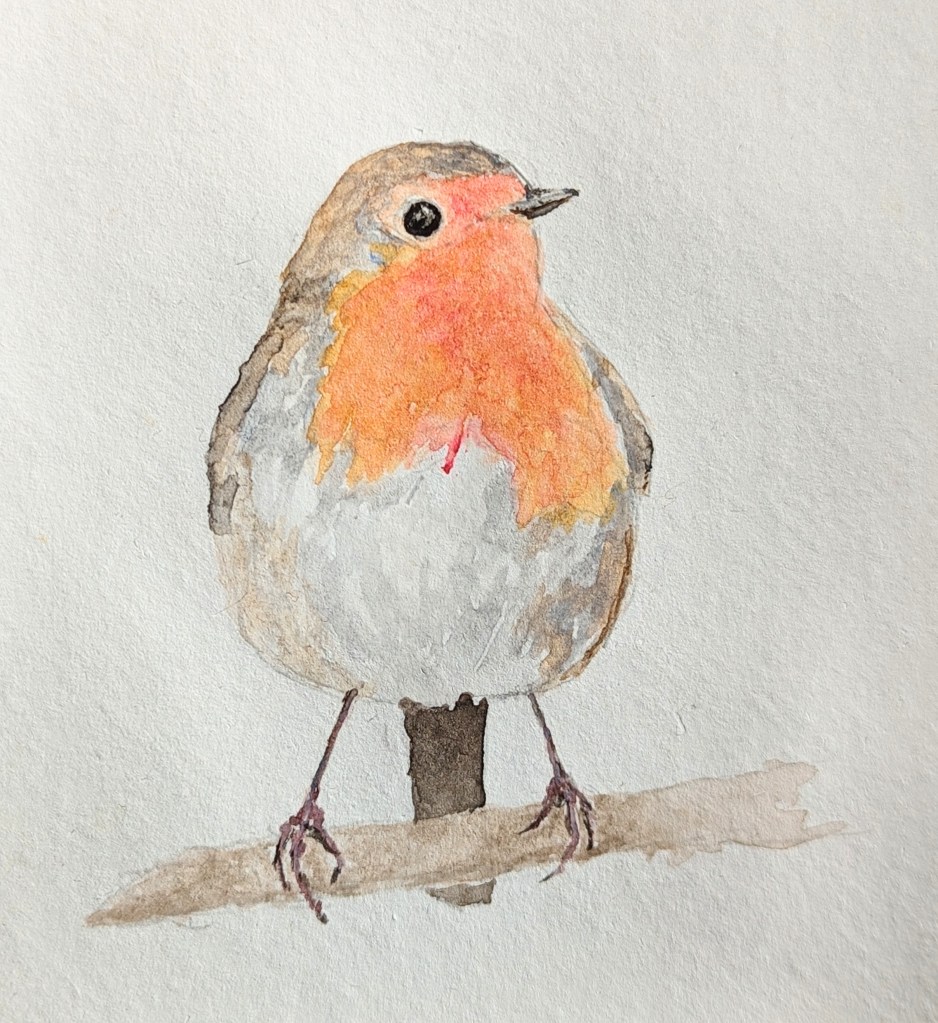
The European robin is small, plump, and markedly different from its taller and more stately American counterpart.

The first time I saw a picture of an Old World robin, I was perplexed. Little did I know, I was just scratching the surface. “Robins” exist in Asia, Africa, Europe, Oceania, and the Americas, and none of them are related. As per usual, the English are to blame, with Anglo ornithologists dubbing any bird with plumage similar to that of the red-breasted European robin (a member of the “chat” subfamily of the Old World flycatchers), a “robin.”4 While the robins of Oceania, for example, may appear similar is size and shape to the OG European robin, they actually compose a unique family, Petroicidae, more closely related to Jays5. Similarly, American robins are members of the Turdidae family of thrushes (a family completely different in build and behavior to Old World flycatchers). Because of their wide range, American robins are known by a variety of (more fitting) indigenous names, including “opitchi” in Ojibwa (thought to be an onomatopoeic representation of their calls),6 and “nikchipkudaagedoo,” in Mi’kmaq, which translates to “leaf rattler.”7


Works Cited

  1. Runwal, P. (2020, July 28). 10 Fun Facts About the American Robin. Audubon Magazine.https://www.audubon.org/news/10-fun-facts-about-american-robin ↩︎
  2. Kaufman, K. (2022, March 28). Ask Kenn: Are American Robins Really a Sign of Spring? Audubon Magazine.https://www.audubon.org/news/ask-kenn-are-american-robins-really-sign-spring ↩︎
  3. American Robin. National Wildlife Federation. https://www.nwf.org/en/Educational-Resources/Wildlife-Guide/Birds/American-Robin#:~:text=The%20breeding%20season%20lasts%20from,houses%2C%20barns%2C%20or%20bridges ↩︎
  4. Kevin. European Robin vs. American Robin (What’s the Difference?). Byrder.com. https://byrder.com/european-robin-vs-american-robin/ ↩︎
  5. Wildlife Journal Junior: Petrocidae-Australian Robins. NH PBS. https://nhpbs.org/wild/Petroicidae.asp ↩︎
  6. Gorzo, J. (2018, July 13). Indigenous Bird Names. Avian Ecologist. https://www.avianecologist.com/2018/08/13/indigenous-bird-names-from-calls/ ↩︎
  7. Wells, J & A. (2024, March 26). Robins in Every Yard. Natural Resources Council of Maine. https://www.nrcm.org/blog/birding-jeff-allison/robins-in-every-yard/#:~:text=Some%20of%20the%20names%20are,we%20see%20every%20day%20now! ↩︎