

If spring could be summated in a single sound, for me it would be the song of the American robin (Turdus migratorius). The roving series of whistles exchanged at increasingly high volumes greeted me before school every April, May, and June morning, and on the opposite side of the country, they still do, imbuing my mornings with nostalgic familiarity. Though I regard them largely with fondness, this is not to say that the robins are never an annoyance—the birds are among the earliest of risers, often starting their dialogues at four in the morning.
As identifiable as their call can be, American robins probably owe their status as a universally identifiable bird (“universal” in this case referring to “across North America”) to their penchant for the urban and suburban landscape, their unique behavior, and distinct plumage. Indeed, the prolific birds are among the most numerous and wide-spread songbirds in North America1, and subsequently carry cultural prominence, often dubbed a “harbinger of spring” (much thanks to Emily Dickinson for that one). Though they are among the first North American songbirds to begin nesting each year, they can usually be found in a given location year round (though likely the individuals one sees in winter are not the same as those present in the summer, as robins do tend to migrate, but not to a specific latitude or for a predictable distance).2 This being said, the birds will move based on available food, and as food is most plentiful in the spring, their ranges are vaster.
All this is to say, I am writing this is Philadelphia in mid April and there are robins abound. Averaging two to three broods per year between April and July,3 they are in mating mode and looking good (the scrappy fledglings so present in the summer have yet to emerge). Watching them hop about in search of worms and grubs, flitting from branches of the dense shrubs in which they’ve secured their nests, it’s impossible to not hoist a bit of literary significance upon their delicate frames—American robins are just too charming.
Why do American robins look nothing like Old World robins?
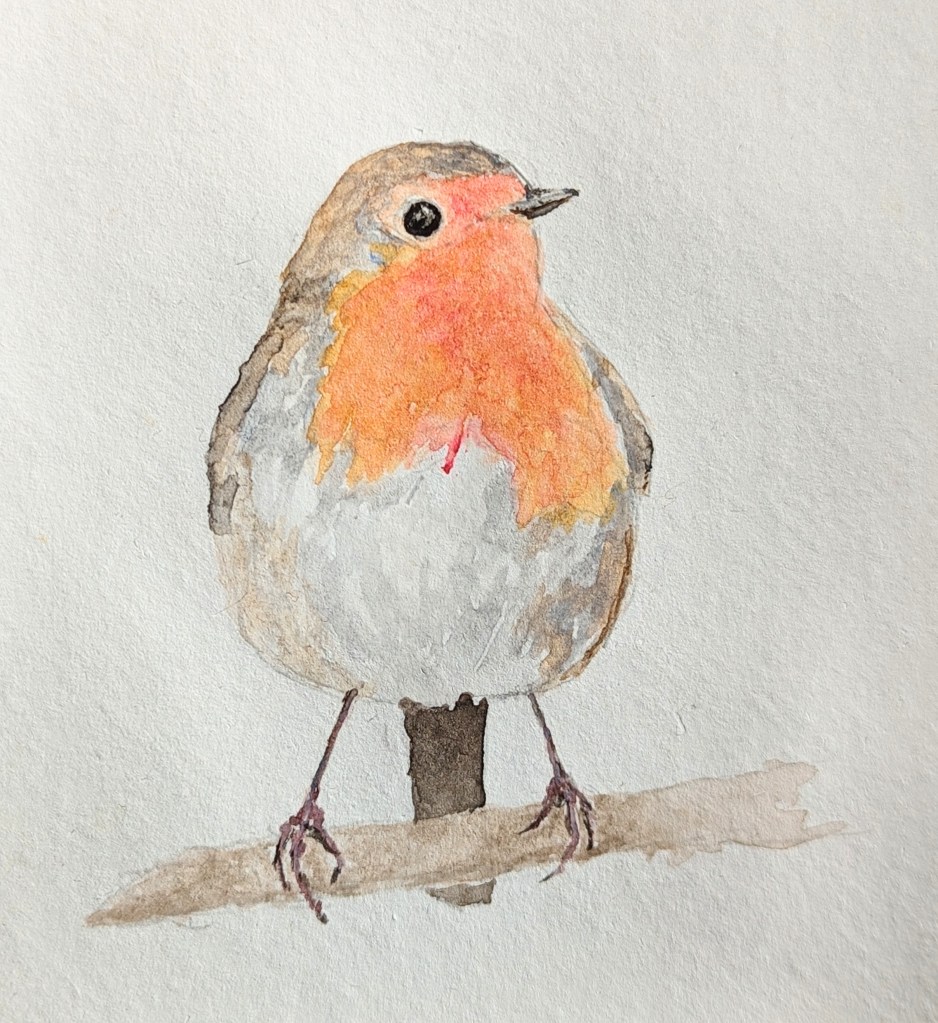
The first time I saw a picture of an Old World robin, I was perplexed. Little did I know, I was just scratching the surface. “Robins” exist in Asia, Africa, Europe, Oceania, and the Americas, and none of them are related. As per usual, the English are to blame, with Anglo ornithologists dubbing any bird with plumage similar to that of the red-breasted European robin (a member of the “chat” subfamily of the Old World flycatchers), a “robin.”4 While the robins of Oceania, for example, may appear similar is size and shape to the OG European robin, they actually compose a unique family, Petroicidae, more closely related to Jays5. Similarly, American robins are members of the Turdidae family of thrushes (a family completely different in build and behavior to Old World flycatchers). Because of their wide range, American robins are known by a variety of (more fitting) indigenous names, including “opitchi” in Ojibwa (thought to be an onomatopoeic representation of their calls),6 and “nikchipkudaagedoo,” in Mi’kmaq, which translates to “leaf rattler.”7
Works Cited
- Runwal, P. (2020, July 28). 10 Fun Facts About the American Robin. Audubon Magazine.https://www.audubon.org/news/10-fun-facts-about-american-robin ↩︎
- Kaufman, K. (2022, March 28). Ask Kenn: Are American Robins Really a Sign of Spring? Audubon Magazine.https://www.audubon.org/news/ask-kenn-are-american-robins-really-sign-spring ↩︎
- American Robin. National Wildlife Federation. https://www.nwf.org/en/Educational-Resources/Wildlife-Guide/Birds/American-Robin#:~:text=The%20breeding%20season%20lasts%20from,houses%2C%20barns%2C%20or%20bridges ↩︎
- Kevin. European Robin vs. American Robin (What’s the Difference?). Byrder.com. https://byrder.com/european-robin-vs-american-robin/ ↩︎
- Wildlife Journal Junior: Petrocidae-Australian Robins. NH PBS. https://nhpbs.org/wild/Petroicidae.asp ↩︎
- Gorzo, J. (2018, July 13). Indigenous Bird Names. Avian Ecologist. https://www.avianecologist.com/2018/08/13/indigenous-bird-names-from-calls/ ↩︎
- Wells, J & A. (2024, March 26). Robins in Every Yard. Natural Resources Council of Maine. https://www.nrcm.org/blog/birding-jeff-allison/robins-in-every-yard/#:~:text=Some%20of%20the%20names%20are,we%20see%20every%20day%20now! ↩︎
 Sophie Aanerud